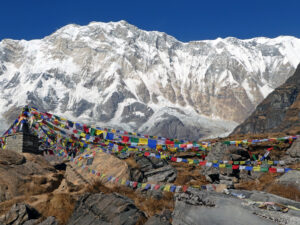
 First, check your altitude limit. Many standard travel insurance policies have a default altitude cap — often 2,500m or 3,000m — that is far lower than the altitudes reached on popular treks like Everest Base Camp (5,364m) or Annapurna Circuit (Thorung La pass, 5,416m). If your policy doesn't explicitly state coverage up to at least 6,000m for trekking, you may not be covered for the altitudes you'll actually reach. Look for policies marketed specifically for 'trekking' or 'mountaineering' with altitude add-ons.
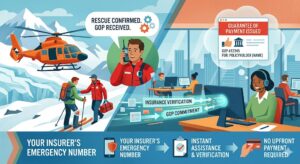 Third, Guarantee of Payment (GOP) is the mechanism that allows a rescue to proceed without the traveller paying upfront. When a case is reported to the insurer's assistance line, their team assesses the situation and, if it meets policy criteria, issues a GOP directly to the rescue operator — essentially a commitment that the insurer will pay the invoice. This is why having your insurer's emergency number (not just a general customer service line) readily available is critical: a rescue operator receiving a verified GOP can dispatch immediately, whereas a rescue without any insurer contact may require upfront payment or a delay while payment is arranged.
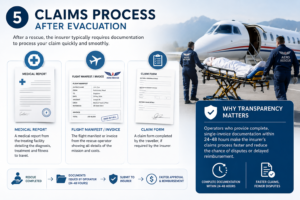 Fifth, the claims process after evacuation. After a rescue, the insurer typically requires documentation: a medical report from the treating facility, the flight manifest/invoice from the rescue operator, and sometimes a claim form completed by the traveller. This is where working with a transparent rescue operator matters enormously — operators who provide complete, single-invoice documentation within 24-48 hours make the insurer's claims process faster and reduce the chance of disputes or delayed reimbursement.